Start here · Stock research
How to research a stock before buying
Start with five questions. Use Alphabet (GOOGL) to learn the workflow, then apply it to a company you want to understand.
By ScalarQuant · Updated
Research a companyEducational example, not a recommendation to buy Alphabet. Investing can result in losses.
Question 1
How does this company make money?
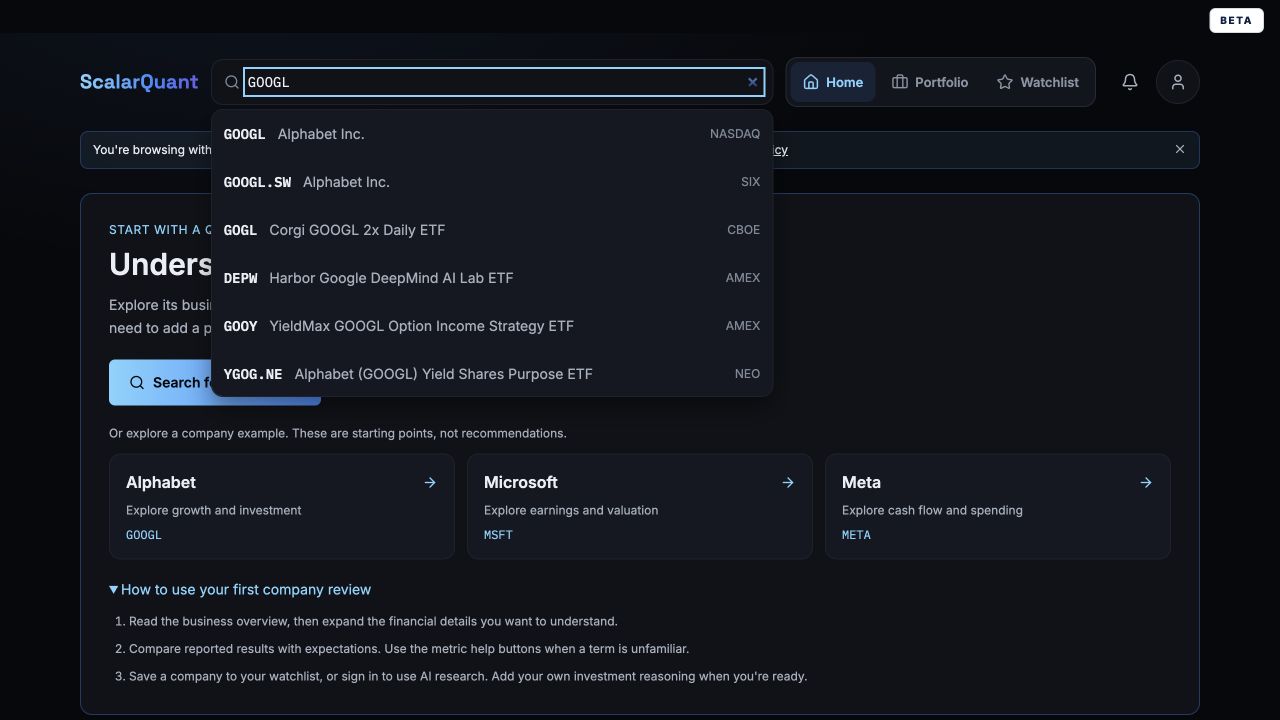
Open ScalarQuant, search for GOOGL, and choose Alphabet Inc. on NASDAQ. Check the company name and exchange: a search can also return funds linked to the same ticker.
Then read the business description in the company's annual report. Who pays it? What products or services generate revenue? What could change customer demand?
For this example, start with Alphabet's investor relations page. The SEC's guide to reading a 10-K and 10-Q explains the Business and Risk Factors sections.
Question 2
Are the reported results improving?
In the company page, find Financials. Switch between Quarterly and Trailing 12M to see the periods separately. Compare like periods and check the filing date.
- Revenue: sales before expenses. Growing sales do not necessarily mean growing profit.
- Net income: profit after expenses. Investigate unusual gains or costs in the filing.
- Cash flow: cash moving through the business. Read the cash-flow statement alongside reported profit.
Use What these numbers mean and the metric help buttons when a term is unfamiliar. Read the limitations as carefully as the definition.
Learn how the statements fit together in the SEC's Beginners' Guide to Financial Statements.
Question 3
What expectations are built into the price?
In Valuation & returns, open the help beside a metric before comparing it. P/E relates share price to earnings per share; a trailing measure uses past earnings. Forward estimates are expectations, not reported results.
A lower multiple alone does not prove that a stock is cheap. Consider the business, growth assumptions, reporting period and comparable companies. Ask what would happen to your reasoning if growth slowed.
Question 4
What would make my idea wrong?
Write down the strongest case against your idea. Read the company's Risk Factors and management discussion, then use Latest coverage to find the original sources behind recent headlines.
An example research question for Alphabet
Could business growth support its investment spending?
Counterquestion: What evidence would show that spending is rising faster than the benefits it produces?
If you use AI research, sign in first. Compare its explanation with the cited sources and notice any limited-evidence warnings. Keep unanswered questions visible.
Question 5
What will I check next?
Use Expectations to examine past earnings surprises and the following price reaction. A reported beat does not guarantee a rising share price.
Finish with a short research note you can revisit:
- The reason I am researching this company.
- The reported evidence supporting that idea, with its date and source.
- The strongest counterargument and anything I could not verify.
- The next report or event I will review, and what would change my view.
Try your first company review
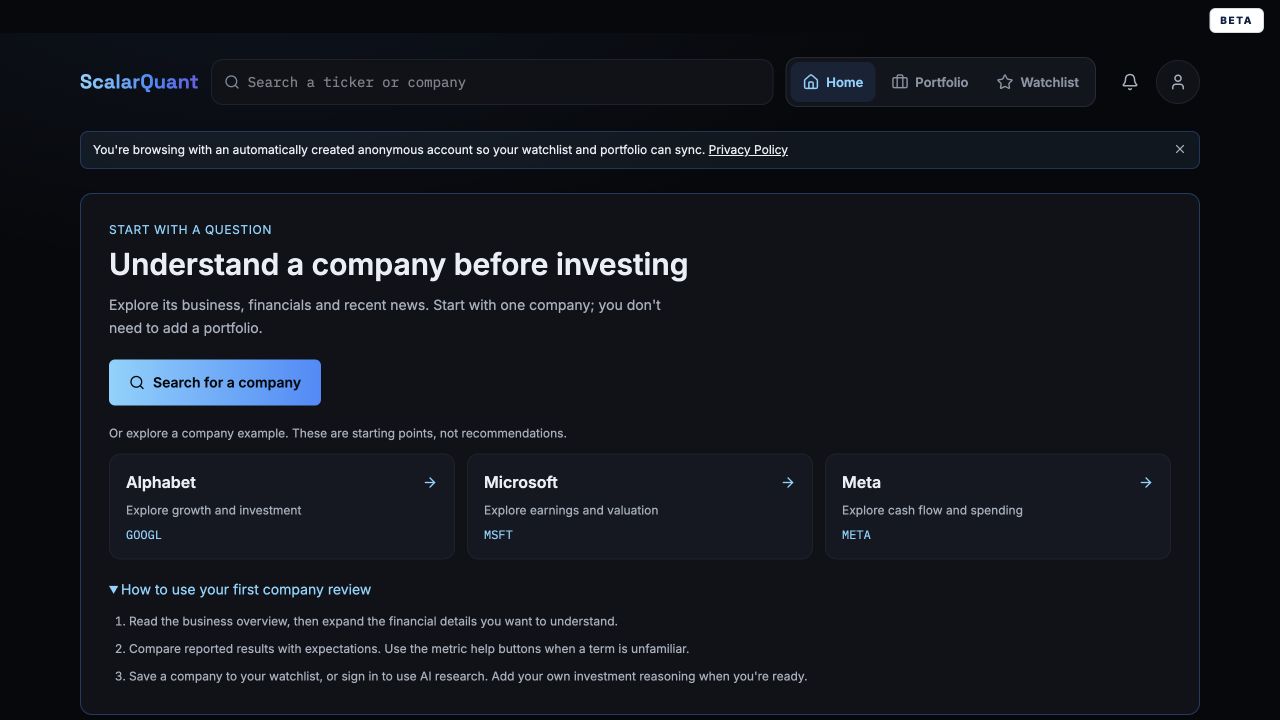
Open ScalarQuant and choose the Alphabet example, or search for a company of your own. Guest stock details are available; AI research requires sign-in.
Research a companyScalarQuant is in beta. This guide is a starting point for research, not personalized investment advice or a forecast of returns. For the risks of stock ownership, see Investor.gov's introduction to stocks.